
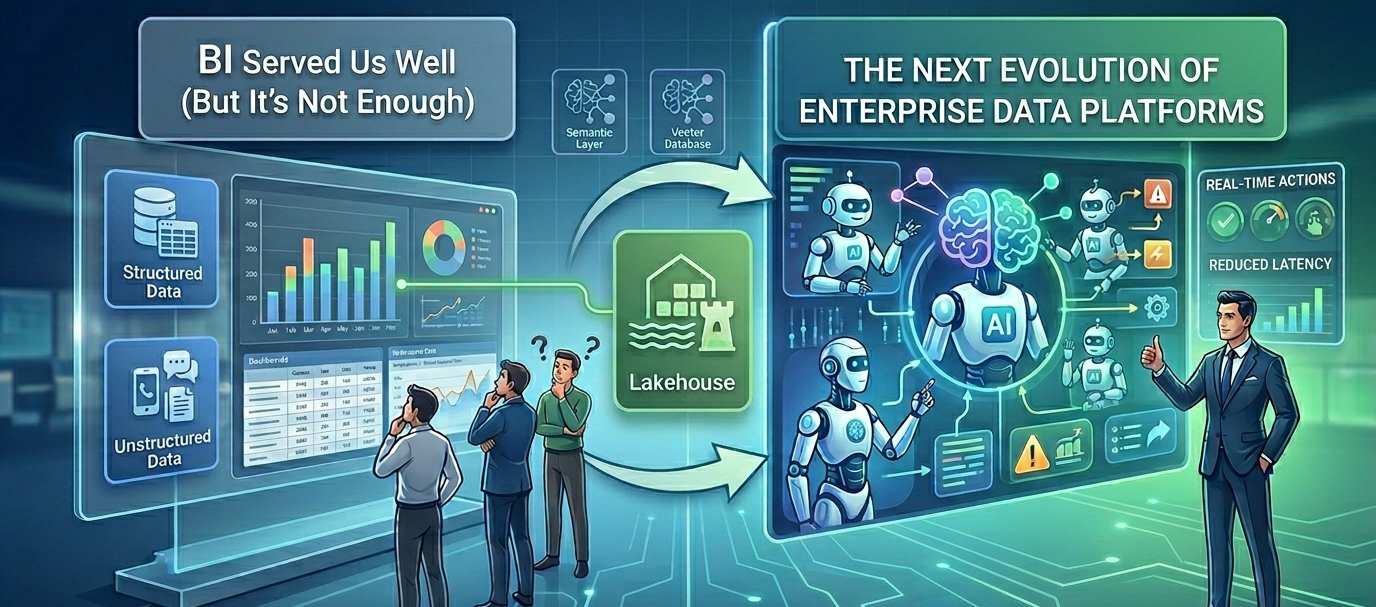
BI Served Us Well – But It’s Not Enough Anymore
A few years ago, having a well-built dashboard was a sign of maturity.
Executives could finally see their business in numbers. Teams aligned around KPIs. Decisions became more data-backed than instinct-driven. Business Intelligence (BI) did exactly what it promised – it made organizations data-aware.
But somewhere along the way, a subtle gap started to emerge.
Leaders weren’t struggling to access data anymore. They were struggling to act on it fast enough.
- A weekly review turns into a debate.
- A spike in churn is noticed – but too late.
- An opportunity is identified – but not executed in time
BI reports resolve issue of data latency but still suffering with decision latency
Where dashboards fall short:
- Delay between insight and action
- Heavy reliance on skilled analysts
- Fragmented view across multiple tools
- Limited ability to incorporate unstructured data (calls, chats, feedback)
- No built-in guidance or recommendations
Enter AI Agents: From Data Consumers to Decision Copilots
This is not about replacing dashboards. And it’s definitely not about replacing humans.
It’s about adding a new layer – an intelligent co-pilot.
AI agents sit on top of your data platform and change how users interact with data. Instead of navigating dashboards, users can simply ask:
“Why did revenue drop last week?”
And instead of just returning a chart, the system responds with:
- A synthesized explanation
- Correlated signals across datasets
- Suggested areas to investigate
Importantly – it should not take action. It assists. It recommends. It guides, the decision still belongs to the human.
What AI agents introduce:
- Natural language interface to data
- Context-aware analysis across systems
- Proactive insights (not just reactive reporting)
- Suggested next steps (human validated)
- Continuous learning from feedback
Architecture Transformation: From Data Stack to Intelligence Stack
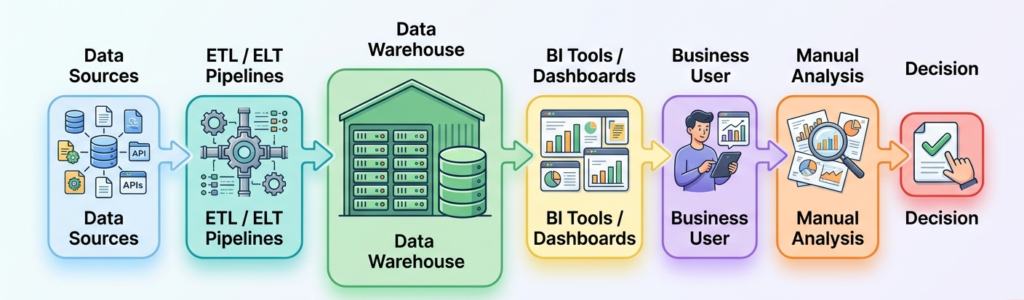
Traditional BI:
It built for data movement and reporting.
Modern systems:
Must support context, reasoning, and interaction.
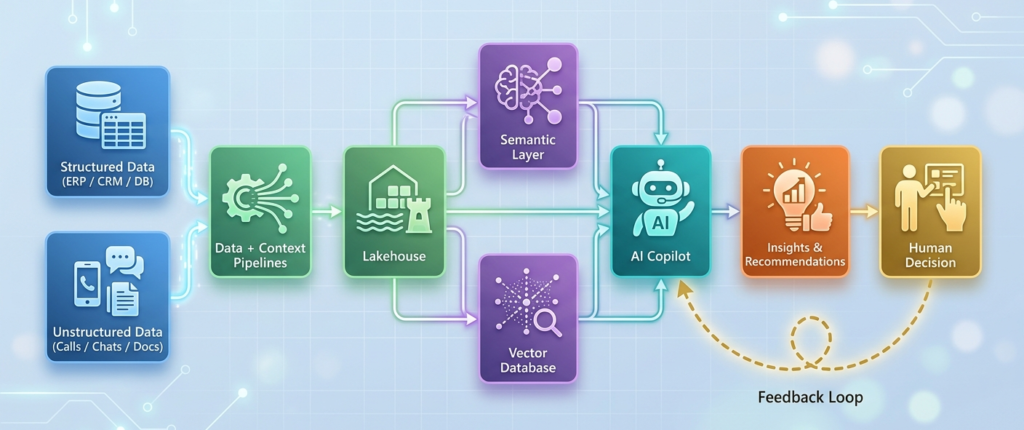
Key architectural shifts:
- Batch pipelines → Real-time + context-aware pipelines
- Structured data → Structured + unstructured fusion
- Dashboards → Conversational interfaces
- Data models → Semantic understanding layers
- Static reports → Dynamic, contextual insights
New Components That Power This Shift
Behind the scenes, several new building blocks can make this possible.
You don’t necessarily need to adopt everything at once – but understanding them is critical.
Core components:
- Semantic Layer
- Defines business meaning (metrics, relationships, context)
- Ensures consistent interpretation across users and systems
- Vector Database
- Enables search across unstructured data (documents, calls, chats)
- Powers context retrieval for AI
- RAG (Retrieval-Augmented Generation)
- Combines enterprise data with LLM reasoning
- Ensures responses are grounded in your data
- Feature Store
- Provides consistent data for analytics and ML use cases
- Agent Orchestration Layer
- Structures how queries are understood, processed, and responded to
- Observability Layer
- Monitors data quality, model outputs, and recommendation reliability
What This Looks Like in the Real World
The shift becomes clearer when you look at practical scenarios.
In customer support, instead of reviewing dashboards for ticket trends, teams receive:
- Suggested issue categorization
- Draft responses based on past resolutions
- Highlighted patterns from customer conversations
In sales, instead of manually analyzing pipeline reports:
- High-priority leads are surfaced
- Engagement insights are summarized
- Suggested outreach strategies are recommended
In finance:
- Anomalies are flagged automatically
- Possible causes are suggested
- Teams validate before taking action
The common thread: faster understanding, better decisions – still human-controlled.
Challenges & Governance: Why Human-in-the-Loop Matters
With great capability comes necessary caution.
AI-generated insights are powerful – but they are not infallible.
Organizations must design systems that are trustworthy, explainable, and controllable.
The goal is not autonomy. It’s augmented intelligence.
Key challenges to address:
- Trust in AI-generated insights
- Explainability of recommendations
- Data privacy in context retrieval
- Bias and inconsistency in outputs
- Monitoring and validation mechanisms
Leadership priorities:
- Keep humans accountable for final decisions
- Build transparency into AI outputs
- Ensure auditability and traceability
- Define clear boundaries for AI suggestions
The Future of Reporting: More Than Just Dashboards
We’re entering a phase where reporting is no longer a separate activity.
It becomes embedded, interactive, and personalized.
Instead of opening a dashboard, users will:
- Ask questions directly
- Receive contextual answers
- Explore follow-ups dynamically
Emerging possibilities:
- Conversational analytics replacing static reports
- Proactive insights delivered automatically
- Personalized views based on role and context
- Unified intelligence across multiple systems
- Predictive insights with suggested actions (human validated)
From dashboards to decision copilots, the next era of data platforms is not just intelligent – it’s collaborative.