

Data Governance: Stop Treating It as an Afterthought

Do the below points sound familiar?

  • We have more data than ever, yet we still don’t have clarity.

  • Why don’t two reports show the same number?

  • We invested millions in data and cloud… Why are decisions still slow?

This is the paradox of the modern enterprise: Data is abundant. Trust is scarce

That is exactly where Data Governance steps in — not as an IT overhead, but as a business-critical capability required for growth, compliance, and competitive advantage. Data Governance is no longer a technical program. It is a business survival strategy. Data Governance is the discipline behind digital winners.

🧩 The Governance Gap: The Silent Killer of Data Investments


Many companies have world-class cloud platforms, analytics tools, and AI pilots. But without governance, they end up with:

  • Conflicting KPIs between teams.
  • Expensive rework and firefighting.
  • Unusable or low-quality data.
  • High exposure to compliance & security risks.
  • AI initiatives that fail quietly due to bad inputs
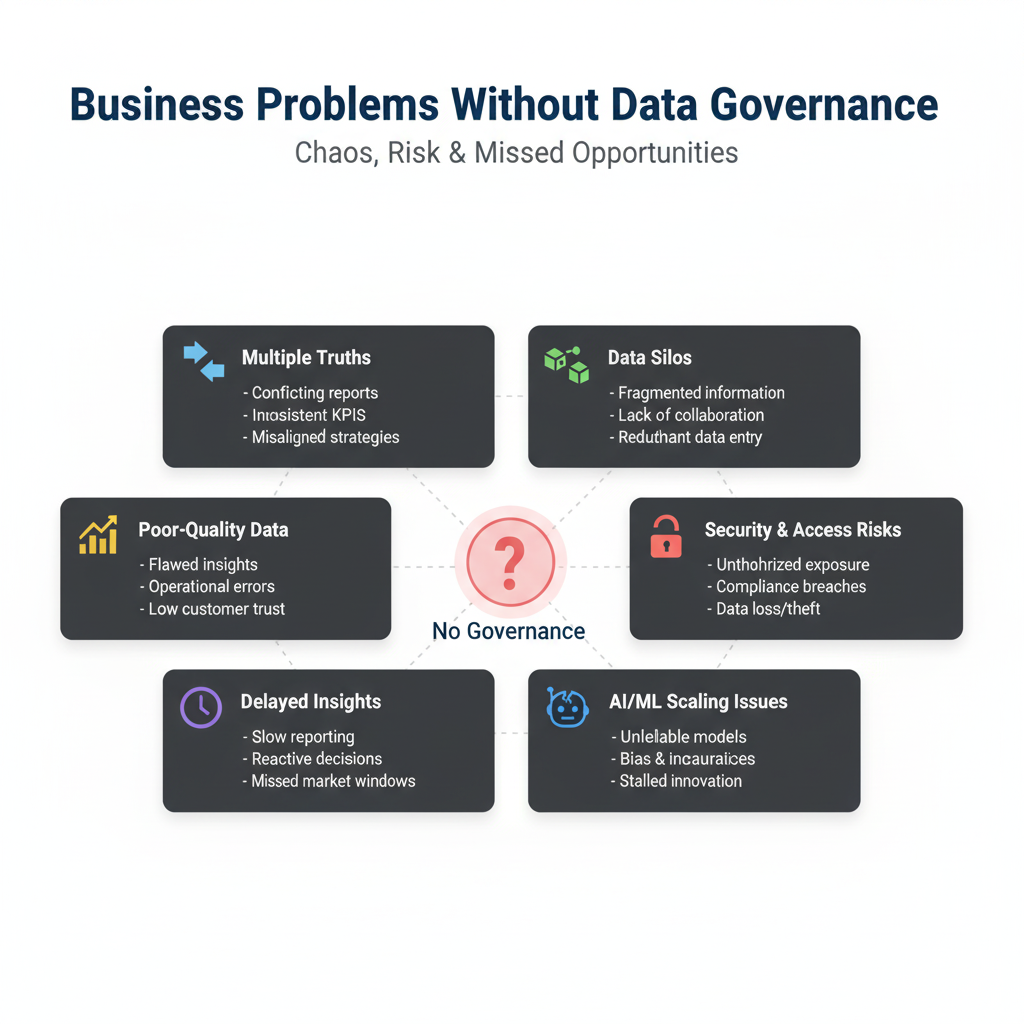
Governance isn’t something you add when things break – it prevents them from breaking in the first place.

🚨 Why It’s a Non-Negotiable Business Necessity

 
  1. Because Decisions Drive Strategy — and Data Drives Decisions
  2. Because Regulatory Risk Is Real
  3. Because AI Fails Without Quality & Control
  4. Because Operational Efficiency Depends on Clarity
  5. Because Customer Experience Demands Precision
 
✅ Data Governance Need Assessment — Quick Checklist
  • Regulatory Preparedness: Do you lack a formal framework for data compliance (GDPR, HIPAA, PCI, etc.)?
  • AI/Analytics Reliability: Do AI models or analytics outputs often produce incorrect, biased, or conflicting results?
  • Data Ownership Clarity: Is it unclear who owns, maintains, or approves different data domains?
  • Operational Efficiency: Do teams waste time reconciling reports or fixing data issues manually?
  • Customer Data Accuracy: Are customer experiences impacted by incorrect, outdated, or duplicated data?
  • Scalability & Integration Readiness: Do new tools or datasets take too long to integrate due to inconsistency?

🔍 How a Well-Governed Enterprise Looks Like?

Governance turns raw data into business-ready, decision-ready assets.

  • Every critical data element has an owner.
  • KPIs and definitions are consistent across departments.
  • Leaders never question where a number came from.
  • Data access is secure, compliant, auditable.
  • Data quality issues are detected early, not after a crisis.
  • AI models perform reliably because inputs are clean.
  • Reporting is fast, accurate, and automated
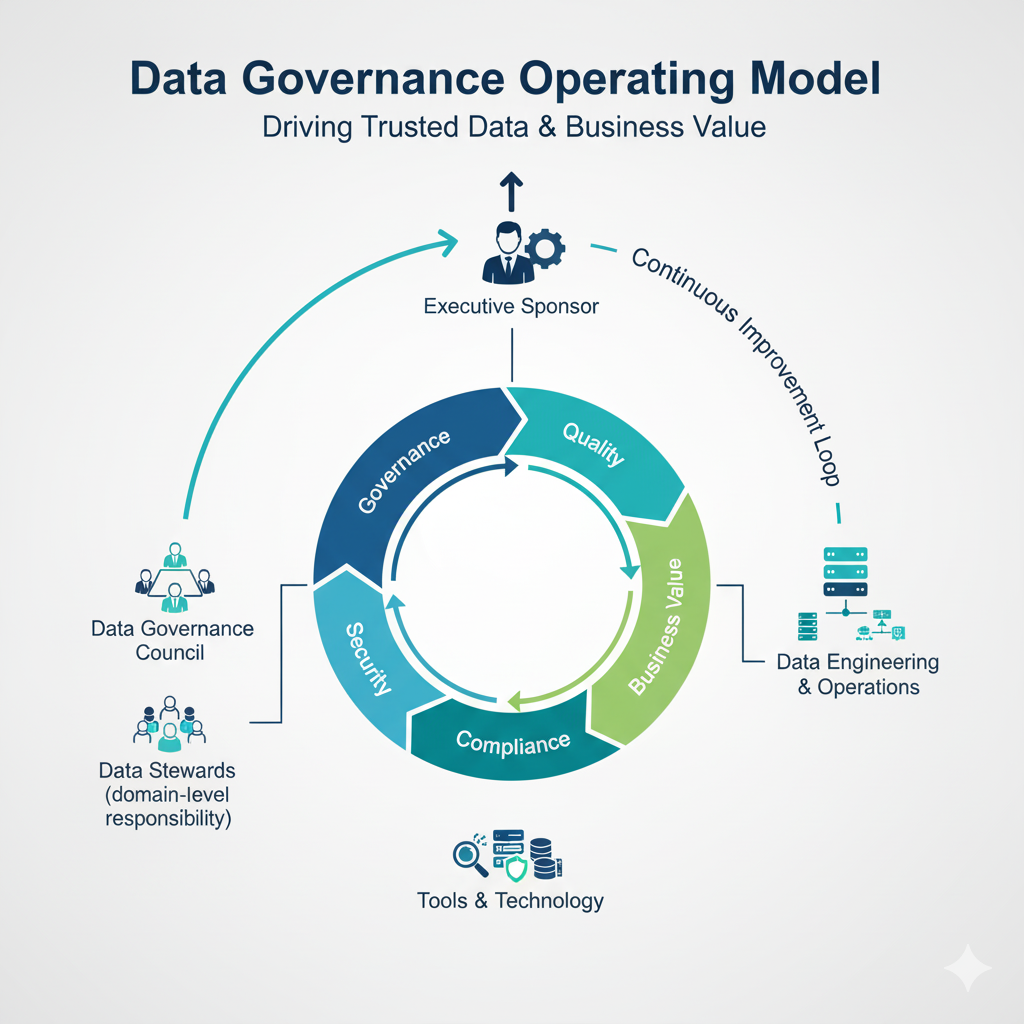
Data Governance: The Strategic Power Move Most Companies Delay

🏛️ Key Components of Data Governance

The trust worthy data has below key component as pillar of there digital footprint.

  • Governance turns raw data into business-ready, decision-ready assets.
  • Data Strategy & Policies
  • Data Ownership & Stewardship
  • Data Quality Management
  • Metadata Management
  • Data Security & Privacy
  • Data Architecture & Lifecycle Management
  • Compliance & Auditability

🏁 Final Word: Governance is the Trust Engine of a Modern Enterprise

Every modern leader wants faster insights, better customer experience, and AI-driven innovation. But none of that is possible without trust in the data that powers it.

Enterprises that Adopt Governance Enterprises that Ignore Governance
✅ Accelerate decision-making ❌ Slow down
✅ Reduce risk ❌ Lose trust
✅ Improve customer experience ❌ Increase risk
✅ Amplify ROI on data & cloud investments ❌ Waste millions
✅ Build reliable AI systems ❌ Fail in AI
✅ Strengthen regulatory posture
The greatest companies don’t govern more data – they govern the right data.
If your organization is struggling with data trust, data quality, or governance gaps, our team can help you build a reliable, future-ready data foundation.